
Voyager 1 Has Escaped the Sun's Huge Bubble
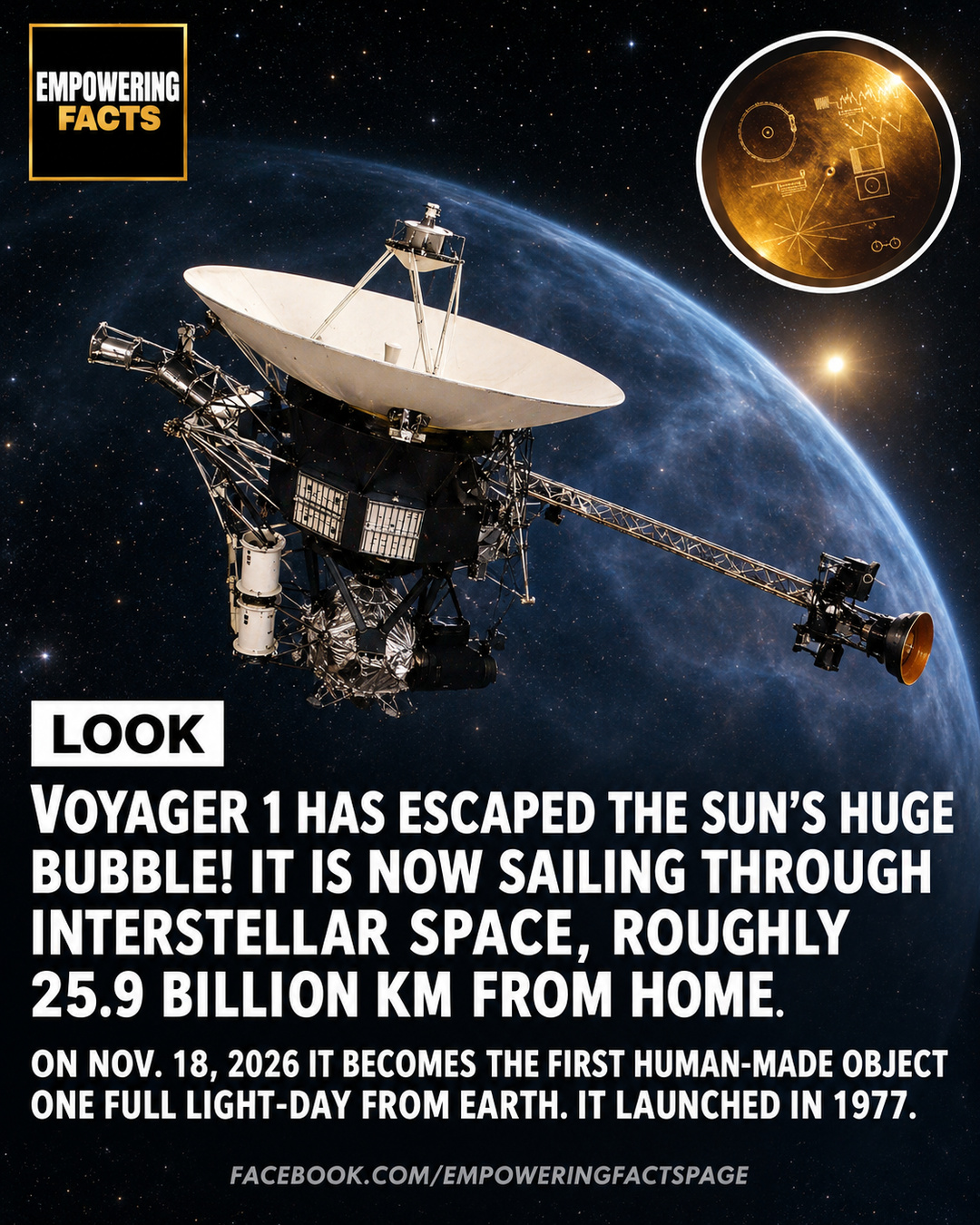
Voyager 1 has escaped the Sun's huge bubble! It is now sailing through interstellar space, roughly 25.9 billion kilometers from home, and on November 18, 2026, it becomes the first human-made object ever to reach one full light-day from Earth.
NASA launched Voyager 1 on September 5, 1977, about two weeks after its twin, Voyager 2. Both were built for a grand tour of the outer planets. Voyager 1 flew past Jupiter in 1979 and Saturn in 1980, sending back the first detailed close-up views of those worlds and their moons. Its path past Saturn's largest moon, Titan, bent its course up and out of the plane of the planets, and it has been heading away from the Sun ever since.
In August 2012, Voyager 1 crossed the heliopause. That is the outer edge of the heliosphere, the giant bubble created by the solar wind, the stream of charged particles that the Sun blows out in every direction. Inside the bubble, the Sun's influence dominates. Outside it is interstellar space, filled with gas and particles from other stars. Voyager 1 was the first spacecraft ever to make that crossing. Voyager 2 followed in November 2018.
The new milestone is about distance. A light-day is how far light travels in 24 hours, about 25.9 billion kilometers or 16 billion miles. NASA announced on June 17, 2026, that Voyager 1 would reach that mark on November 18. No object humans have ever built has gone this far.
That distance shapes every day of the mission. Radio signals travel at the speed of light, so a command sent from Earth now needs a full day to reach the spacecraft, and its reply needs another full day to return. Engineers send an instruction and wait about two days to learn whether it worked. When something goes wrong, a fix that would take minutes on Earth can take weeks.
Power is the other challenge. Voyager 1 runs on a radioisotope thermoelectric generator, which turns heat from decaying plutonium into electricity. That output drops a little every year. To stretch what is left, the team has switched off most of the spacecraft's science instruments and heaters over time, keeping only what is needed to keep it talking. The fact that a machine built in the 1970s still answers Earth after 49 years is one of the great engineering stories in history.
Voyager 1 also carries a message. The Golden Record, a gold-plated copper disc, holds greetings in dozens of languages, music from many cultures, natural sounds of Earth, and encoded images, along with instructions for playing it. It was meant as a time capsule for anyone who might find it in the far future.
Even at one light-day, Voyager 1 is barely at the start of the journey. It would take tens of thousands of years to pass close to another star.
Should NASA keep Voyager running as long as it can still talk? YES OR NO?