80% of the World's Problems Involve Old Men Hanging on Who Are Afraid of Death
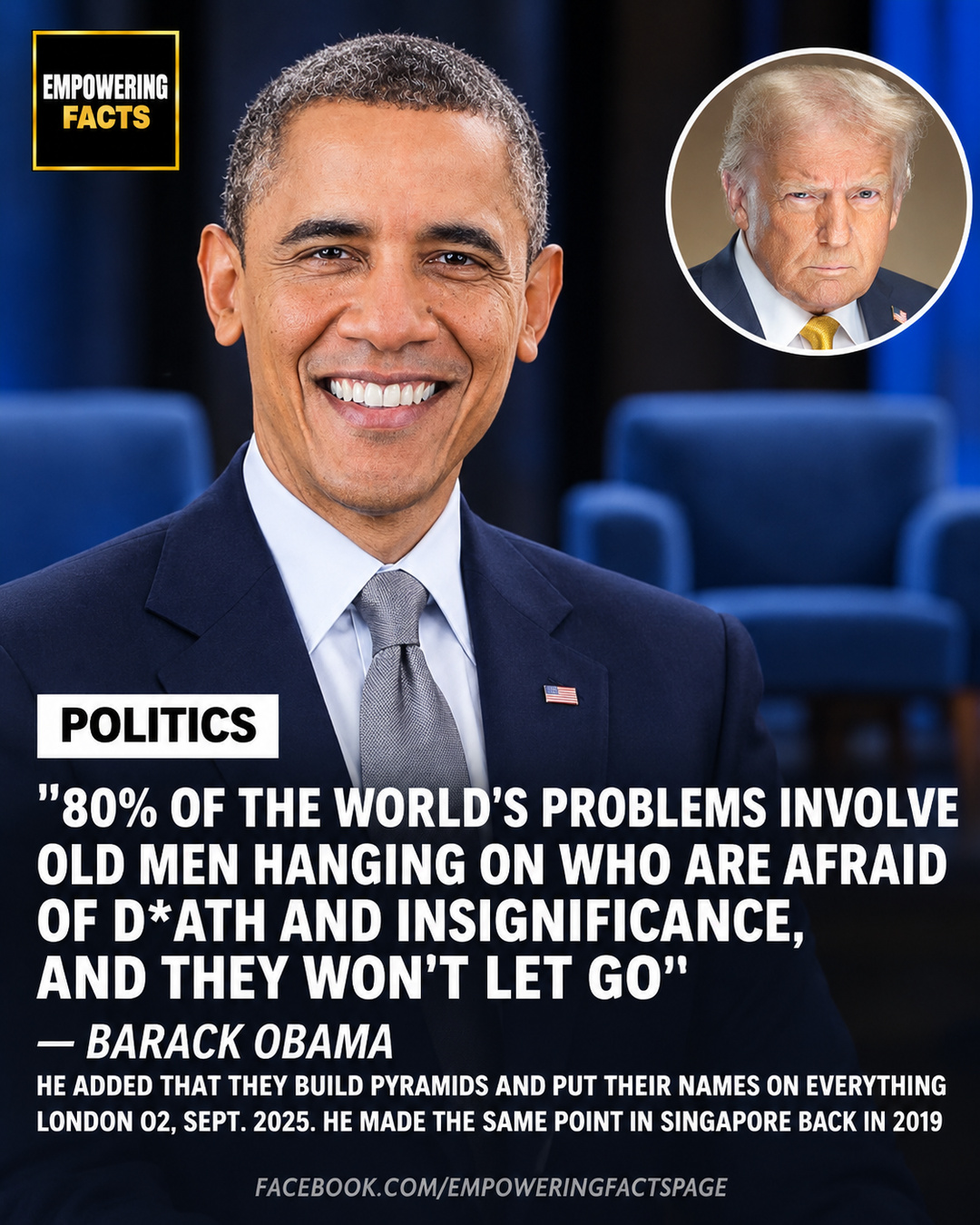
Barack Obama made the remark on stage at London's O2 Arena in September 2025, in conversation with the historian David Olusoga.
"It's fair to say that 80% of the world's problems involve old men hanging on who are afraid of death and insignificance, and they won't let go," Obama said. "They build pyramids, and they put their names on everything. They get very anxious about it."
Most coverage read it as a veiled reference to Donald Trump, and the timing made that reading difficult to avoid. Obama did not name anyone, and the construction was general rather than personal, which is the form he has used for this argument before.
The argument was not new for him. He made a closely related point in Singapore in 2019, telling an audience that a great deal of the world's problems come from old men not getting out of the way, and adding around the same period that women are pretty indisputably better than men at leadership. The 2025 version is sharper and considerably funnier, but it is the same thesis he has been advancing for six years. That continuity matters, because it makes the line harder to dismiss as an improvised jab at a single rival.
Snopes examined the quote after it went viral and confirmed that the event took place, noting that Obama's own account posted a clip matching the circulating video. It left the claim formally unrated because no official transcript was available and the viral clip lacked surrounding context. That is a reasonable position on exact wording rather than a challenge to whether he said it, and it is a useful reminder that a quote can be real while its precise phrasing is still unsettled.
The pushback was immediate and fairly obvious. Obama is 64, remains one of the most visible figures in his party, continues to command substantial fees for exactly this kind of appearance, and has a presidential library carrying his name. More than a few people suggested he take his own advice. The pyramid line in particular was read back to him by critics who found it an unusual image for someone with a large building project of his own.
That objection is fair without being fatal. Obama left office at the end of two terms, did not attempt to extend them, and handed over power on schedule. That specific behavior is what the quote is actually about. Remaining influential after leaving office is a meaningfully different thing from refusing to leave it, even if the line between the two gets blurry in practice and even if the people standing on the wrong side of it rarely recognize where they are.
The deeper point survives the hypocrisy argument in either direction. Across a large number of countries at the moment, the people holding the most consequential decisions are notably old, were in power when the current problems began, and show little intention of handing anything over. That is observable without taking a position on any individual. Whether 80 percent is the right figure is beside the point. Obama picked a number for effect, the way people do on a stage, and the number is doing rhetorical work rather than statistical work.
What gives the line its force is the psychological claim rather than the demographic one. Obama is not arguing that older leaders are less competent. He is arguing that the fear of becoming insignificant is itself a policy input, and that decisions get made to postpone a personal reckoning rather than to solve a public problem. That is a harder accusation than a complaint about age, and it is much harder to answer, because nobody in that position will ever concede that it describes them.
The pyramid detail is the sharpest part. Monument building is one of the few leadership behaviors that is visible from the outside and difficult to justify on any other grounds. When a leader starts putting their name on infrastructure, the motive is rarely obscure. Obama's critics turned that observation on him immediately, which is itself evidence that the test he proposed is a usable one.
It is worth separating the two arguments people have been having about this quote. One is whether Obama is the right person to make the point. The other is whether the point is correct. Those are independent questions, and the first one gets much more attention than the second, which is usually a sign that the second one is uncomfortable.
From 1 to 10, how well does this describe the leaders you can name? Drop your number.