NASA's Juno Spacecraft Spotted a Strange Flashing Green Light on Jupiter
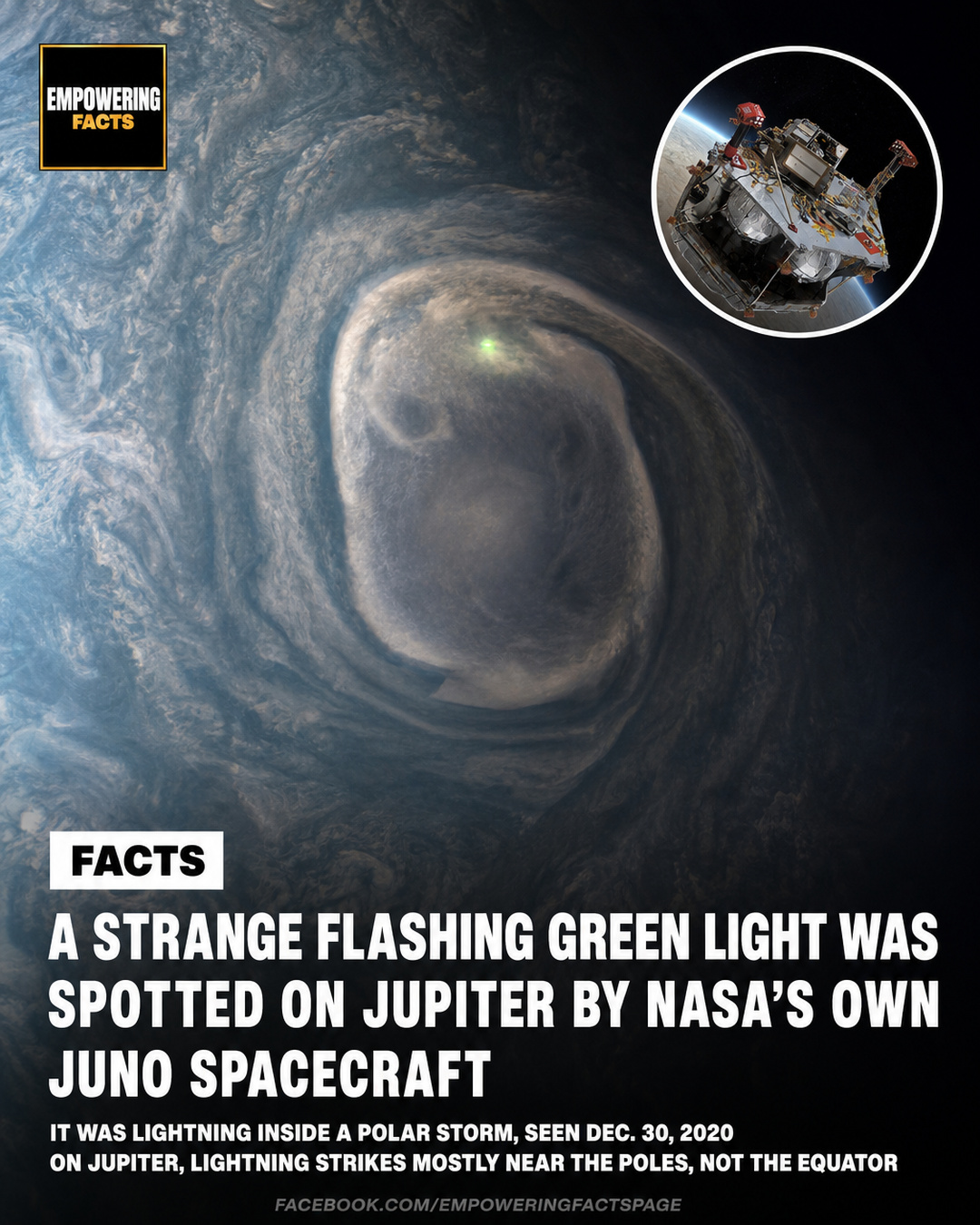
A strange flashing green light was spotted on Jupiter by NASA's own Juno spacecraft. For a moment it looks like something out of science fiction. The real answer is more familiar, and in some ways more surprising: it is lightning.
The image was captured on December 30, 2020, as Juno completed its 31st close flyby of the giant planet. Its camera was pointed at a vortex, a huge rotating storm, near Jupiter's north pole. Pale blue and cream cloud bands curl around the center of the storm, and inside that swirl sits one small, bright green point. That point is a lightning flash, caught at the exact moment the camera took its picture.
The finished image was not produced by a NASA team. In 2022, citizen scientist Kevin M. Gill processed it from raw data captured by JunoCam, the spacecraft's visible-light camera. JunoCam was designed for public engagement rather than as a main science instrument. NASA posts its raw images online, and anyone can download them and process them into finished pictures. Gill and other amateur image processors have made many of the most widely shared views of Jupiter from the past decade this way.
The location of the flash is what interests scientists most. On Earth, lightning strikes most often near the equator, where the sun heats the surface hardest and warm, wet air rises quickly into storm clouds. On Jupiter the pattern is reversed, and lightning is most frequent near the poles. The flashes form inside clouds made of ammonia and water. Researchers think the difference comes down to heat. Jupiter's equator receives more sunlight, which can make the air there more stable, while the poles have less of that stabilizing warmth, so heat rising from deep inside the planet can drive storms more freely.
Juno is in a rare position to watch this happen. The spacecraft launched in August 2011 and entered orbit around Jupiter on July 4, 2016. Its long, looping orbit carries it low over the poles on its close passes, giving it a view that earlier missions to Jupiter never had. Juno was the first spacecraft to study the planet's poles up close, and it found them packed with clusters of giant cyclones.
Lightning has been one of Juno's recurring discoveries. In 2020, the mission team reported "shallow lightning," flashes much higher in Jupiter's atmosphere than scientists believed was possible, linked to slushy hailstones of ammonia and water ice that researchers nicknamed "mushballs." Each new pass has added detail to a picture of a planet with weather far more violent than anything on Earth.
The green tint in this picture comes from how the camera data was processed. The flash itself is real, glowing inside a storm larger than many countries on Earth, more than 400 million miles from home, photographed by a spacecraft and finished by a volunteer working from a computer at home.
Would you want to see a storm on Jupiter up close? Tell us why below.