Astronomers Spot One of the Biggest Black Holes Ever Found
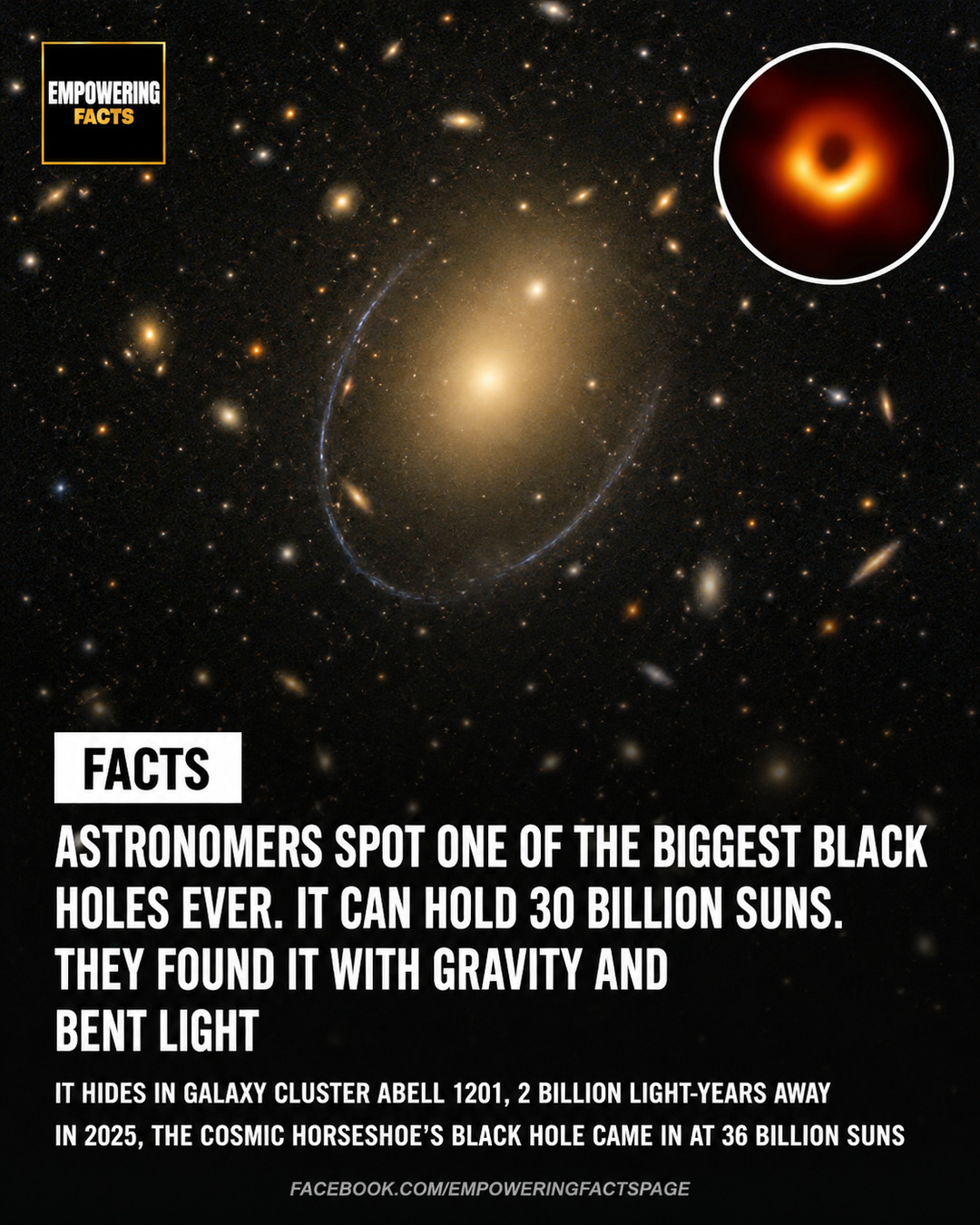
Astronomers have spotted one of the biggest black holes ever found. It can hold about 30 billion suns, and the scientists found it with gravity and bent light, because the black hole itself is completely dark.
The black hole sits at the heart of a giant galaxy in the cluster Abell 1201, more than 2 billion light-years from Earth. A team led by Dr. James Nightingale of Durham University in the United Kingdom published the discovery in March 2023 in the Monthly Notices of the Royal Astronomical Society. Their best estimate for its mass was about 32.7 billion solar masses. For comparison, the black hole at the center of our own Milky Way, Sagittarius A*, weighs about 4 million Suns. The Abell 1201 black hole is more than 8,000 times heavier.
Finding it took a new approach. Most supermassive black holes are spotted when they are actively feeding. Gas spiraling into them heats up to extreme temperatures and glows brightly enough to see across the universe. The black hole in Abell 1201 is quiet. It is not swallowing much of anything, so there is no glow to point to.
Instead, the team used gravitational lensing, an effect predicted by Albert Einstein. Anything with mass bends the space around it, and light passing nearby follows that bend. The galaxy hosting the black hole is so heavy that it acts as a lens, bending and magnifying the light of another galaxy far behind it. Using images from the Hubble Space Telescope and the DiRAC COSMA8 supercomputer at Durham, the researchers ran hundreds of thousands of simulations, each with a black hole of a different mass, to see how each would bend the light of the background galaxy. A black hole of around 30 billion Suns produced the best match to what Hubble saw.
It was the first black hole ever found this way. Nightingale said the method allows astronomers to study inactive black holes in distant galaxies, which was not possible before, and the team expects it could reveal many more hidden giants.
The black hole is not the largest ever measured, despite how it is often shared online. In 2025, a separate team reported a black hole of about 36 billion solar masses at the center of the Cosmic Horseshoe galaxy, measured by combining gravitational lensing with the movement of the galaxy's stars. The distant quasar TON 618 has been estimated at around 66 billion solar masses, though that figure relies on a different, less direct method.
What all of these giants share is a puzzle. Scientists are still not sure how black holes grow this large. Some may have formed from the merging of many smaller black holes as galaxies collided over billions of years. Each new measurement, especially of quiet black holes like this one, helps test those ideas.
The image of a black hole on this post's inset is the real M87 black hole, photographed by the Event Horizon Telescope in 2019.
Which space mystery do you most want solved in your lifetime? Tell us below.