
Barred from Public Lands: One New US Bill Wants Current AI Data Centers Removed
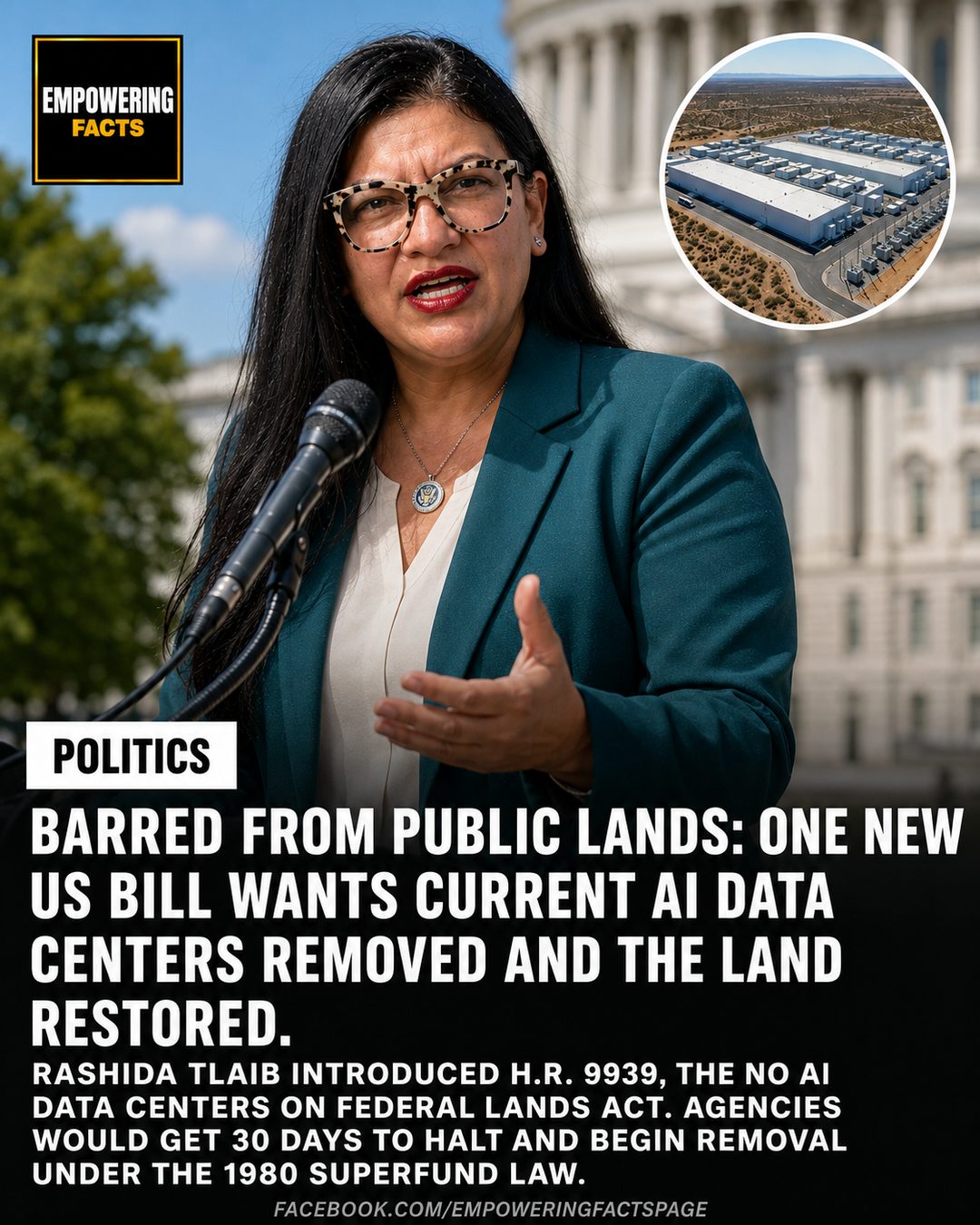
A new bill in Congress would permanently ban large AI data centers from public land, and it does not stop at blocking future construction. It would require the ones already built to be removed, and the ground underneath them restored to what it was before.
The bill has a number and a sponsor. Representative Rashida Tlaib of Michigan introduced H.R. 9939, the No AI Data Centers on Federal Lands Act, in the 119th Congress. The text bars the construction or operation of an AI data center or its associated infrastructure on any land owned or managed by the United States. The phrase "associated infrastructure" is doing real work there, because a data center is never just a building. It arrives with substations, transmission lines, water intake, cooling plant and access roads, and a ban that covered only the server hall would leave most of the footprint untouched. The bill also names military bases specifically rather than leaving them to be argued about later, which closes the route most likely to be used to get around a general prohibition.
The removal mechanism is the part that got the least coverage and carries the most weight. Any federal agency currently operating, leasing, building or constructing a qualifying data center would have 30 days from the date of enactment to stop operations or construction and begin removal. That is a compliance window measured in weeks rather than budget cycles, and critically it reaches projects already underway rather than only new proposals. Removal would then have to proceed under the Comprehensive Environmental Response, Compensation, and Liability Act of 1980, the law most people know as Superfund. That statute requires restoration of damaged natural resources, not simply demolition and a cleared pad. It is a materially higher standard, it is expensive, and it puts the cost of putting the land back on the party that developed it.
Five members have signed on as cosponsors: Jim McGovern of Massachusetts, Adelita Grijalva of Arizona, Delia Ramirez of Illinois, Mark Pocan of Wisconsin and Bonnie Watson Coleman of New Jersey.
The bill arrives in the middle of an active fight rather than out of nowhere. Congress has been ramping up scrutiny of Pentagon plans to site AI data centers on defense property, with lawmakers pressing for detail on how sites are being selected, what agreements are being signed, and who bears the cost of the electricity and water those facilities consume. Federal land has become attractive to data center developers for straightforward reasons. The parcels are large, much of the land is already disturbed, transmission access is often nearby, and the permitting path runs through a single owner instead of a county board and a dozen private sellers.
The argument behind the bill is about resource draw. A large AI training facility consumes electricity at industrial scale and, depending on its cooling design, substantial water in regions where water is already contested. Supporters say land held in trust for the public should not become private compute capacity. Opponents say domestic AI capacity is a strategic necessity and federal siting is the fastest route to it.
What happens next is the ordinary part. A bill introduced with five cosponsors and no committee action is a marker rather than a law, and the overwhelming majority of bills introduced in any Congress never receive a floor vote. What H.R. 9939 does accomplish immediately is put a specific removal standard and a specific 30-day clock into the legislative record, in text other members can lift and reuse.
Do you support banning AI data centers from federal land? Tell us why or why not below.