
Mount Everest Holds Marine Rocks: The Tallest Point on Earth Was Once at the Bottom of the Sea
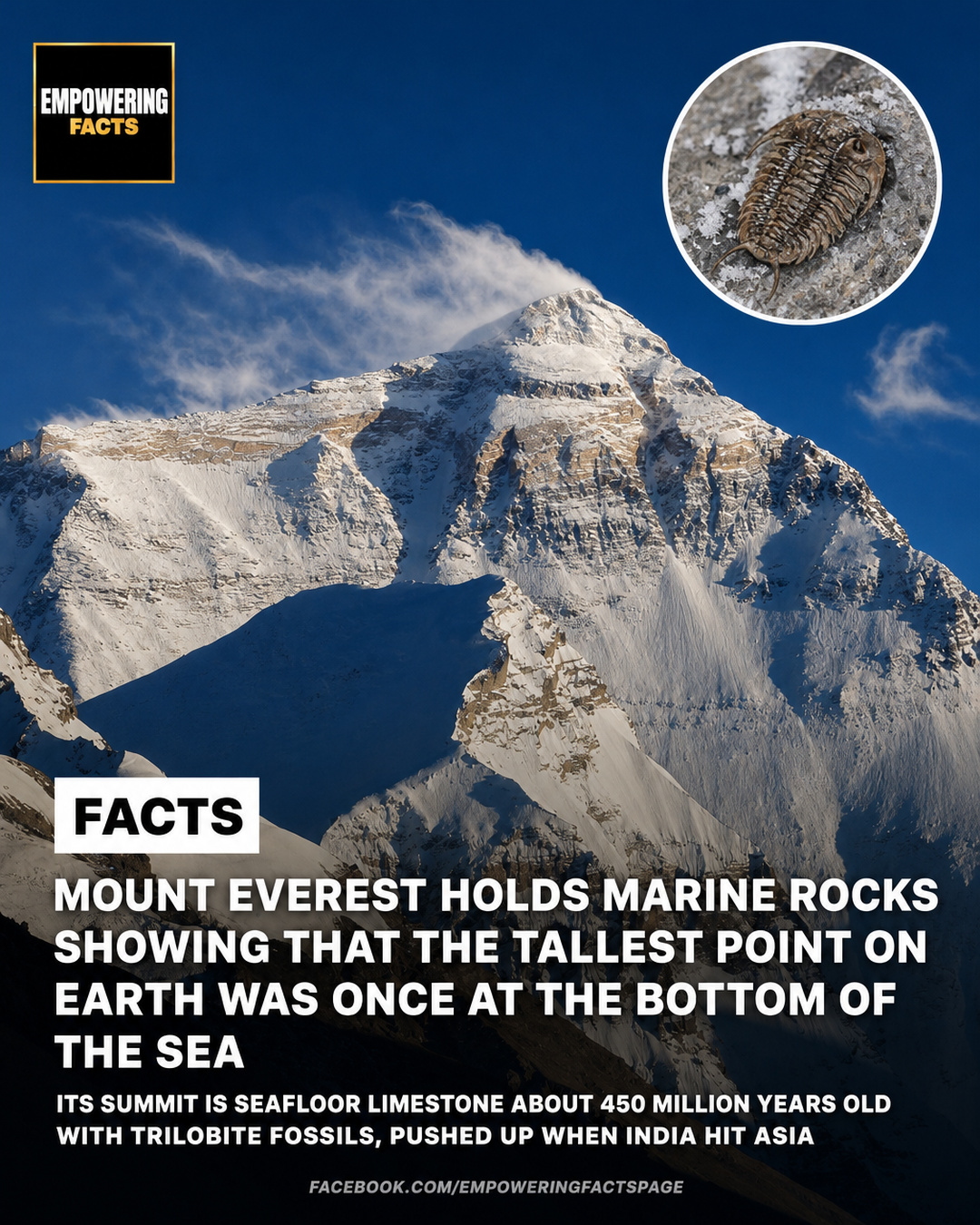
Mount Everest holds marine rocks, showing that the tallest point on Earth was once at the bottom of the sea. It sounds impossible, but geologists have confirmed it many times. The climbers who reach the summit are standing on the floor of an ocean that vanished hundreds of millions of years ago.
The top of Everest is made of limestone from a rock unit called the Qomolangma Formation. The name comes from Qomolangma, the Tibetan name for the mountain. Limestone is a rock that forms underwater. It builds up from the shells, skeletons, and other remains of marine life that settle on the seafloor and harden over millions of years. Geologists date the summit limestone to the Ordovician period, roughly 450 to 470 million years ago, more than 200 million years before the first dinosaurs. At that time, the area was covered by a warm, shallow tropical sea, close to the equator.
The rock still holds traces of the life in that sea. Researchers who studied samples from near the summit found fragments of trilobites, hard-shelled animals that are distant relatives of crabs and insects. They also found pieces of crinoids, sometimes called sea lilies, which look like plants but are animals related to starfish, along with brachiopods and tiny shelled creatures called ostracods. Most of these fossils are small and broken, and many can only be seen clearly when the rock is cut into thin slices and studied under a microscope. The large spiral shells that appear in many viral images of Everest are not what climbers actually find at the summit.
So how did an ancient seafloor end up nearly nine kilometers above sea level? The answer is plate tectonics. Earth's outer shell is broken into huge plates that move slowly over time. The Indian plate broke away from an ancient southern landmass and moved north across the ocean for tens of millions of years. About 50 to 55 million years ago, it collided with Asia. Neither plate could easily slide beneath the other, so the crust between them crumpled, folded, and stacked upward. Layers of old seafloor rock were thrust high into the air, building the Himalayas, the highest mountain range on the planet.
That collision is still happening. India continues to push north into Asia, and the Himalayas continue to rise slowly, while wind, ice, and weather wear them down at the same time.
The height of Everest itself has been measured many times. In 2020, China and Nepal jointly announced an official height of 8,848.86 meters, or 29,031.7 feet above sea level, after survey teams from both countries took measurements at the summit.
Every rock on top of the world is a reminder of how much the planet can change. The ground that now holds the highest point on Earth was once home to sea creatures swimming in a tropical ocean.
Did this change how you think about mountains? Tell us below.