On the Day I Left Office, I Handed Trump the Strongest Economy in the World
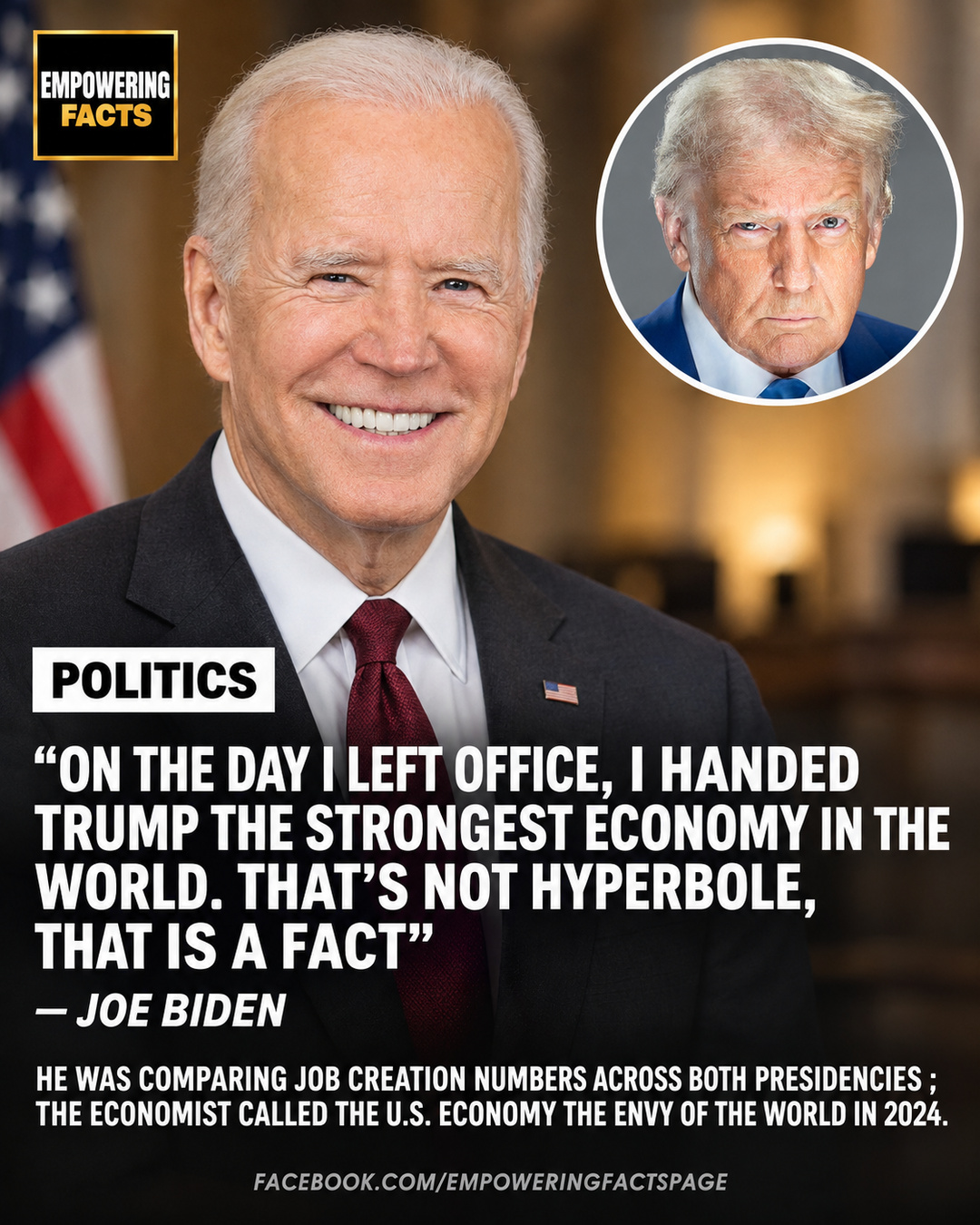
Joe Biden delivered the line during a speech to the South Carolina Democratic Party, and clips of it have been circulating since.
"On the day I left office, I handed Trump the strongest economy in the world," Biden said. "That's not hyperbole, that is a fact."
He was making a specific comparison rather than a general boast. The speech was built around job creation figures under each presidency, and the claim rested directly on that contrast. Biden has used the phrase "strongest economy in the world" repeatedly going back several years, including in his final White House economic materials and in a 2024 CNN interview, so the wording is a long-running formulation rather than something coined for this appearance.
The underlying economic argument has partial outside support. The Economist described the American economy as the envy of the world shortly before the 2024 election, which is close to the assessment Biden is invoking. Commentators who went through the speech generally found that narrower macro claim defensible on the aggregate numbers, while noting that the wider historical account he offered around it was looser than the economic point itself. That is a fair summary of where it lands: the headline claim holds up better than the story built around it.
On the aggregate numbers, the case is real. The United States came out of the pandemic period with stronger growth and a faster labor market recovery than most comparable advanced economies, and it avoided the recession that a large share of forecasters had treated as close to inevitable. Measured against Europe over the same window, the gap was wide enough that the comparison was not controversial among economists even where the politics were.
The harder question is the one this quote keeps colliding with, which is why strong aggregate numbers did not translate into political credit. Biden spent much of his term arguing that the macro picture was better than the public mood suggested, and he was repeatedly criticized for appearing to wave off weak consumer confidence rather than engage with what was driving it. Grocery prices, rent and borrowing costs do not appear in a GDP print the way they appear in a household budget. A person can be employed, see their wages rise, and still feel materially worse off because the price level reset and did not come back down. Inflation falling does not mean prices falling, and that distinction was never successfully communicated.
That gap is a significant part of why the 2024 election went the way it did, and it is the reason this quote reads as vindication to some people and as denial to others. Both reactions are responding to different real things. The aggregate data and the lived experience diverged, and arguing about which one counts as the economy is close to the whole of American economic politics right now.
The venue is not incidental either. South Carolina's 2020 primary rescued Biden's presidential campaign after poor showings in Iowa and New Hampshire, and he later moved the state to the front of the Democratic nominating calendar while in office. Returning there to make an argument about his record is a deliberate choice of audience, in front of people with a specific stake in how that presidency is remembered.
There is also the question of what the claim is for. Biden is not on a ballot again. The argument he is making is about how his presidency gets recorded, and more specifically about whether the economic conditions of the following years are attributed to his policies or his successor's. Every outgoing president makes some version of this argument, and the handoff claim is one of the most durable genres in American politics precisely because it can never be settled cleanly. Policy effects lag, they overlap across administrations, and the lag is long enough that whoever is in office when conditions change tends to collect the credit or the blame regardless of cause.
That fight over attribution usually outlasts the people having it, and it is generally resolved by economists working long after the political usefulness has expired.
Who do you credit for the economy you are living in right now? Drop a name.