Salvini: 5 Million in Italy Live in Absolute Poverty, Italians Come First
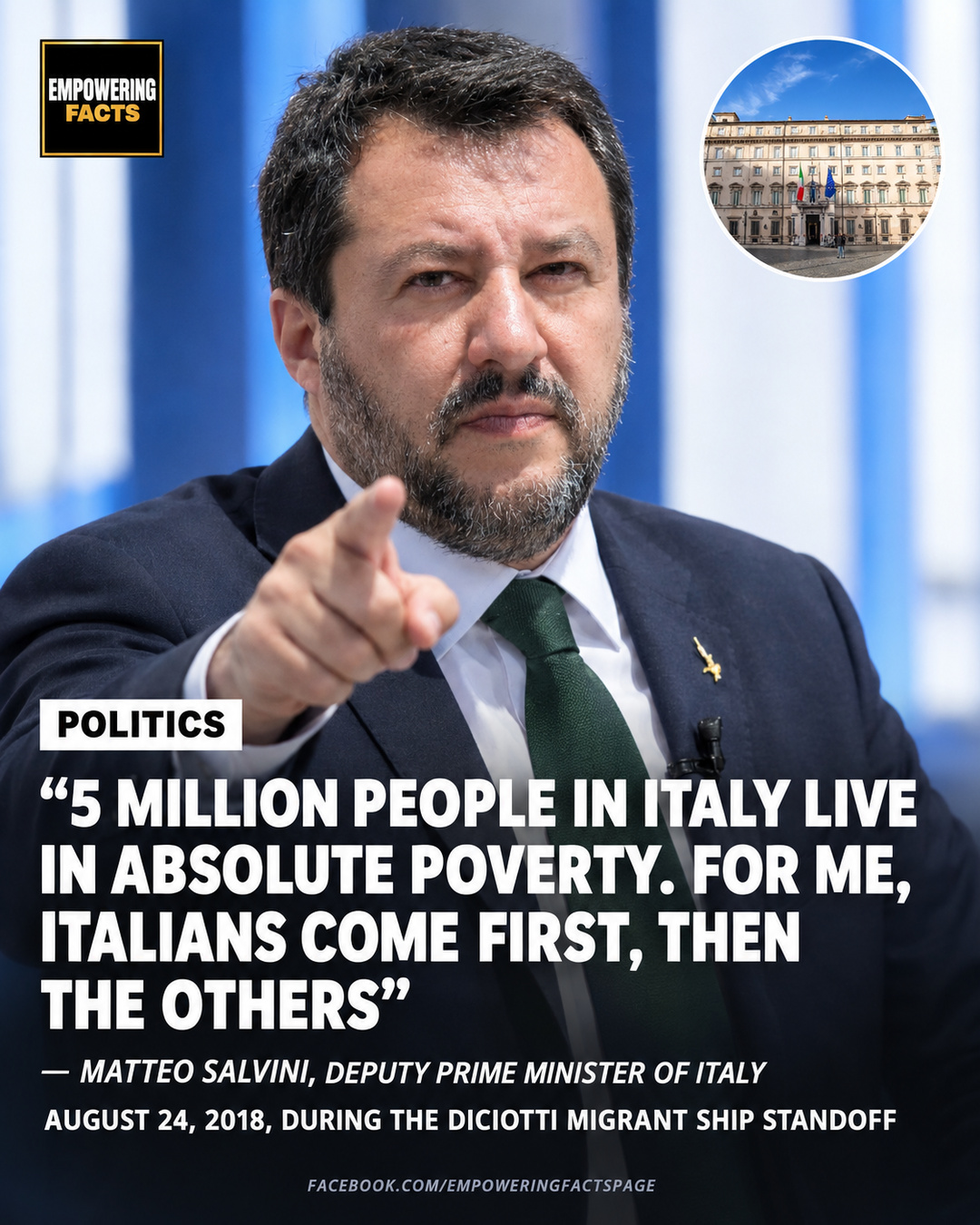
"5 million people in Italy live in absolute poverty. For me, Italians come first, then the others."
Matteo Salvini said it on August 24, 2018. At the time he was Italy's Deputy Prime Minister and Interior Minister, the official in charge of the country's borders and migration policy. He leads the League party and today serves as Deputy Prime Minister once again. The line has followed him through every chapter of his career since.
The words came in the middle of the Diciotti standoff, one of the most heated migration fights in Europe that summer. The Diciotti, a ship of the Italian coast guard, had rescued migrants in the Mediterranean and brought them to the port of Catania in Sicily. Salvini refused to let them disembark until other European Union countries agreed to take a share of them. The ship sat at the dock for days. Some of the migrants on board began a hunger strike.
Salvini did not move. "They can do as they like, I'm not changing my mind," he said. He cited 2017 figures from Istat, Italy's national statistics office, showing 5 million people in Italy living in absolute poverty, including 1.2 million children. Those people, he said, go hungry every day while critics stay silent. Then came the line that defined his position: Italians first, then the others. He finished by daring the courts: "Does some judge want to arrest me for this? No problem, I'm waiting."
The numbers drew a closer look. Fact-checkers noted that the 5 million counted everyone living in Italy, not only citizens. About 1.6 million of the people in absolute poverty were foreign residents, roughly one in three. Around 3.4 million were Italian citizens.
The standoff did not end at the dock. Prosecutors in Sicily later sought to charge Salvini with kidnapping over his refusal to let the migrants off the Diciotti. Because he was a sitting senator and minister, the case needed approval from the Italian Senate. In 2019, the Senate voted to deny it, and the prosecution did not go forward.
The episode helped make Salvini one of the best-known faces of Europe's push for tighter borders. Supporters saw a leader who finally put his own citizens ahead of everyone else, and who was willing to face prosecution to do it. Critics saw a politician using the country's poorest families as an argument against rescued people at sea.
Years later, the debate he started at that dock in Catania is still going on in Rome, in Brussels and in Washington: who a country owes first, and how much it can afford to give.
The 2017 Istat report he cited showed absolute poverty in Italy at its highest level since 2005, which made the number a powerful talking point. His critics turned the same report back on him, noting that foreign residents were far more likely than citizens to be living in poverty.
Should a country take care of its own poor before accepting new migrants? YES OR NO?