Walz’s Gun-Control Comparison Needs Context About Licensed Ownership
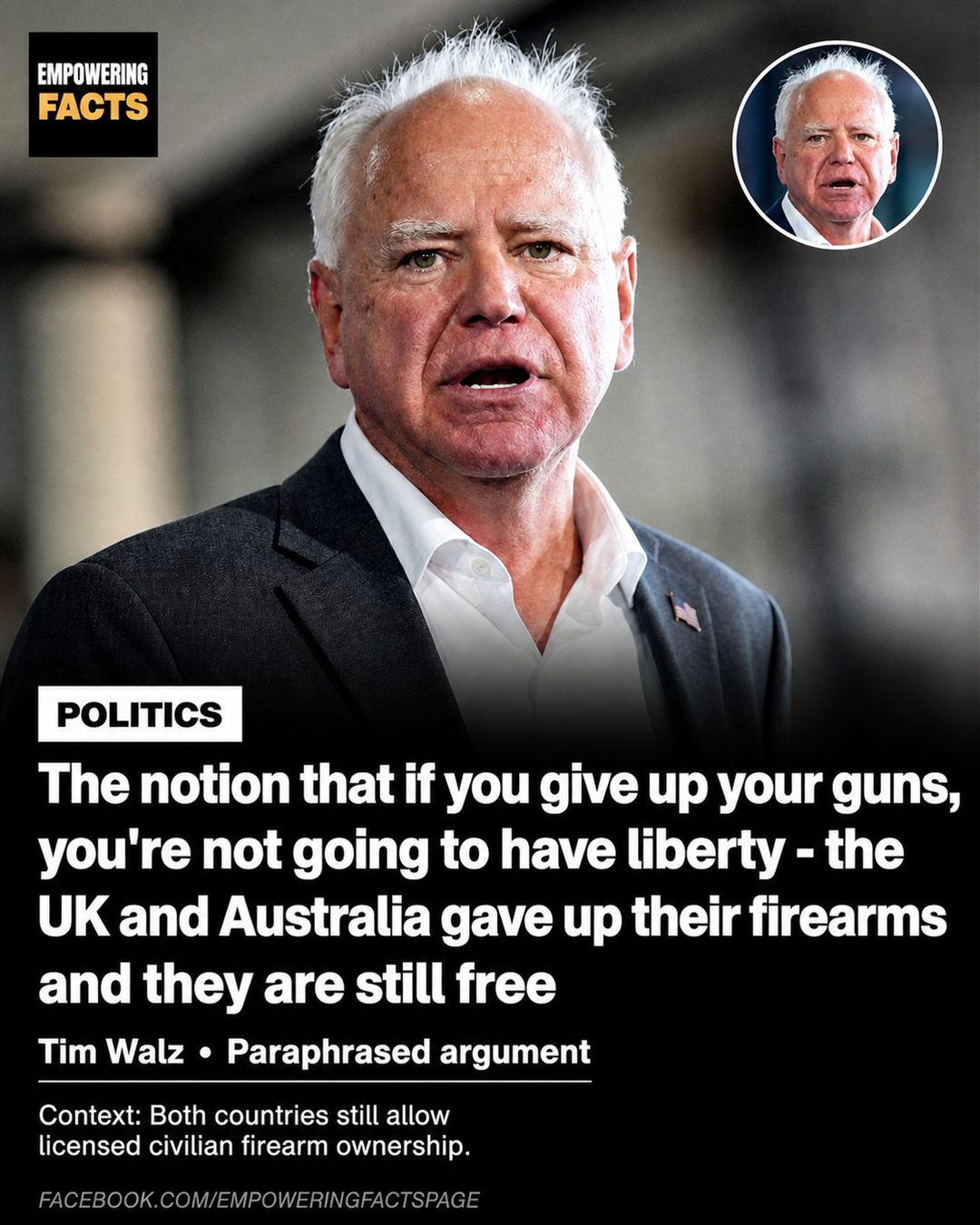
Minnesota Governor Tim Walz has argued that the United States should look to Australia and Scotland on gun laws, saying people in those countries "are just as free as we are."
When and why he said it
Walz made the comments in September 2025, days after a deadly shooting during a school Mass at Annunciation Catholic Church in Minneapolis. In response, Walz said he would call a special session of the Minnesota Legislature to pass new gun measures, and pointed to other countries that tightened their laws after mass shootings.
The remarks drew sharp criticism from gun rights groups and Republicans, who noted that during the 2024 presidential campaign, when Walz was Kamala Harris's running mate, he had said no one was coming for Americans' guns.
The EF graphic paraphrases his argument. It does not reproduce a verified word-for-word transcript.
What Australia and Scotland actually did
Both countries changed their laws after mass shootings in 1996.
In Australia, a gunman killed 35 people at Port Arthur, Tasmania, in April 1996. Within weeks, the national and state governments agreed to the National Firearms Agreement, which banned most semi-automatic rifles and pump-action shotguns, required licensing and registration, and paid owners to hand in banned weapons. Around 650,000 firearms were bought back and destroyed.
In Scotland, 16 children and their teacher were killed at a primary school in Dunblane in March 1996. The United Kingdom then banned almost all private ownership of handguns in 1997.
Neither country "gave up" its guns
There is an important factual point here. Civilian gun ownership is still legal in both countries, under strict licensing.
In the UK, people can apply to their local police for firearm and shotgun certificates, mainly for hunting, pest control and sport shooting. Applicants need a good reason, references and a background check. Australia keeps a national firearms register of licensed owners and their guns, and farmers and sport shooters remain common license holders.
So the accurate description is heavy regulation, not a total ban.
Why the comparison is contested
The United States is a very different case. It has far more guns than people, with estimates of about 120 firearms for every 100 residents, and the Second Amendment protects an individual right to keep and bear arms, as the Supreme Court confirmed in 2008 and again in 2022. A national buyback or licensing system like Australia's would face major constitutional and political hurdles.
Supporters of tighter rules point to sharp falls in mass shootings in Australia and the UK since the 1990s. Opponents argue those results cannot be transferred to a country with a constitutional right to bear arms, and that law-abiding owners should not pay for the crimes of others.
Readers can disagree with Walz's conclusion while describing those countries' systems accurately.
Should the U.S. adopt Australia-style gun laws? YES OR NO?